The useful starting point
Plan home charging around driving, parking, available time and electrical capacity, with an explicit comparison of energy management and service upgrades.
Start with the energy you need to replace
A home charger is useful because it replenishes driving energy while the vehicle is parked. Begin with typical daily driving, the vehicle’s energy use and the dependable hours available at home. Add occasional demanding days as a separate scenario. Designing everything around the shortest possible recharge can push the project toward capacity and connection work the household does not otherwise need.
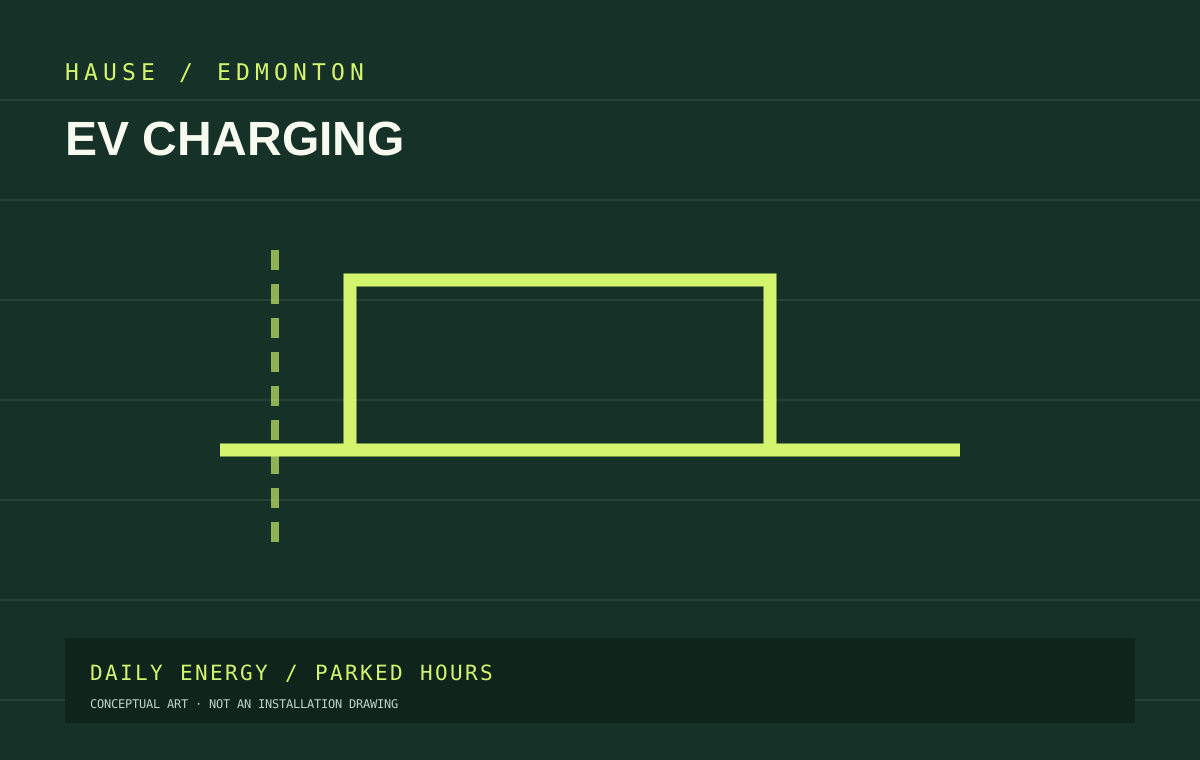
For a planning example, daily energy in kWh is distance in kilometres multiplied by energy use in kWh per 100 km, divided by 100. Dividing that energy by the available hours gives the average delivered charging power needed for the scenario, before losses or interruptions. These are energy arithmetic steps, not an electrical load calculation or permission to install a particular circuit.
Use the vehicle’s own reported experience if available. Label assumptions for cold weather, driving mix and charging losses. Do not publish a fixed winter penalty for every Edmonton vehicle. A useful planning result shows ordinary days, demanding days and the backup plan when time at home is shorter.
The parking location is part of the electrical design
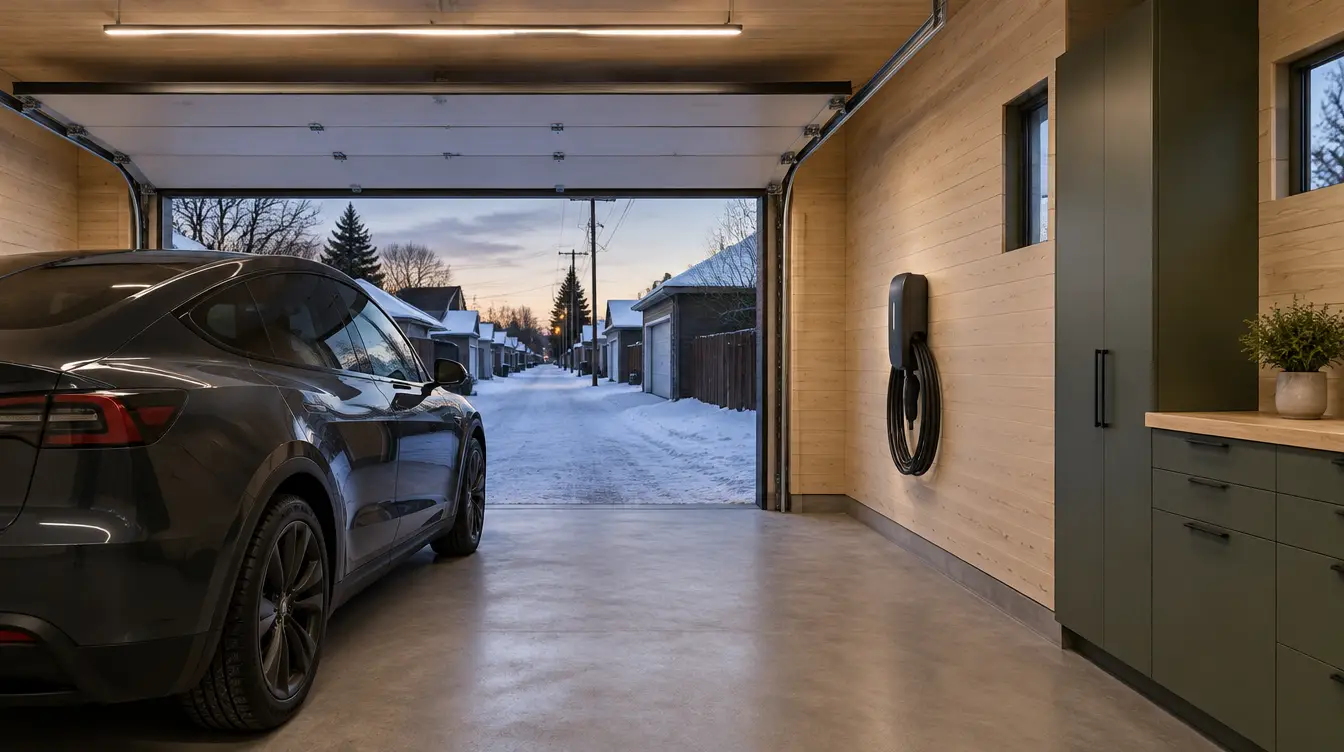
Map where the vehicle actually parks, how the charging lead will reach it and whether the path conflicts with a door, walkway or second vehicle. A detached garage can create a different route from an attached garage. A driveway installation can have different equipment and access considerations from an indoor wall installation. These practical facts should precede a hardware purchase.
Ask the contractor to describe the cable route, equipment location and finishing work. A short straight-line distance on a plan may hide several walls, structural obstacles or an underground route. Identify which surfaces need protection and who repairs them. Share planned changes to the garage, driveway or backyard building so the installation does not obstruct the next project.
For outdoor equipment, the designer must select an appropriate installation for the actual exposure. Owners can help by describing snow-clearing, vehicle movement, watering and access patterns. Do not use an extension lead or improvised arrangement to compensate for a location that has not been designed.
Compare three distinct charging approaches
The EPCOR home charging guide distinguishes basic charging, dedicated higher-power charging and EV energy management. It notes that a higher-power charger may require electrical changes. This is the appropriate local source for starting a conversation about options; it does not replace assessment of the home.
The first approach is meeting the daily charging task at a lower charging rate where a suitable compliant arrangement exists. The second is providing a dedicated higher-power installation supported by the available electrical capacity. The third is a controlled arrangement that limits or pauses charging when other demand uses the available capacity. Ask the electrician which options are viable and why.
A comparison should state the charging behaviour the owner will notice. If a managed system pauses, how will the household know? If several vehicles share charging, how are their needs prioritized? If the equipment loses communication, what is its intended safe behaviour? A product label alone does not describe the completed operating system.
Separate charging arithmetic from code demand
The charging task calculation tells you what the driver would like the vehicle to receive over time. The electrical demand calculation tells the designer whether the proposed installation fits the supply and distribution arrangement under the applicable rules. Those answers are connected but are not interchangeable. Avoid an online “spare amps” result based on subtracting breaker labels.
Prepare the equipment inventory the electrician needs: cooking, heating, cooling, water heating, laundry, outdoor equipment, suites and other significant loads. Note planned future changes as future changes. A gas appliance today and an electric replacement next year should not be hidden in a project intended to last.
A breaker position, panel bus rating and incoming service capacity each answer a different question. Ask the contractor to explain the limiting item in your proposed installation. That explanation makes the quotation easier to evaluate than a simple instruction to buy a larger panel.
Include permits, commissioning and operating instructions
An EV charging installation appears on the City of Edmonton residential permit guidance. Ask the permit holder how the charging installation fits the overall building project and which inspection records will be supplied at completion. For a condominium or a shared building, use the appropriate building and governance process rather than assuming homeowner eligibility.
At handover, ask for the selected equipment’s documents, the installed circuit identification, settings that affect charging, required owner maintenance and the expected behaviour of any energy management equipment. Record any app ownership and transfer procedure. A vehicle that charges once at handover does not prove that every future use pattern has been considered.
Before selecting a contractor, give the charging task, parking layout, known electrical information and future plans. If a service upgrade is proposed, request a separate explanation of utility dependencies and restoration. This makes it possible to compare a managed option and a connection upgrade on their real operating tradeoffs.
Use a transparent example, then replace the assumptions
Suppose a driver enters 60 km per day, 20 kWh per 100 km and eight dependable parked hours. The arithmetic gives 12 kWh of daily driving energy and 1.5 kW of average delivered power before losses. These are user-selected hypothetical inputs, not measured Edmonton fleet data or a charger recommendation. Changing the parked time or daily distance changes the result directly.
The interesting decision is what to do on days that exceed the ordinary scenario. Options may include more time parked, a different household charging schedule, a supported higher rate or another charging opportunity. Keep those choices visible instead of hiding them inside a single oversized default.
Use the charging planner to prepare a brief, then ask the electrician to assess the installation. The brief should retain all assumptions and state explicitly that capacity, equipment approval and permit decisions are outstanding.
Leave covers, conductors and service equipment to the appropriate electrical professional. Do not work on energized equipment. An urgent hazard needs emergency or utility response, rather than an online project request.
Questions / Direct answers
Common questions
How much charging power do I need at home?
Can energy management avoid an Edmonton service upgrade?
Can I add the two numbers on a double-pole main breaker?
Does this planner approve a charger circuit?
References / Jurisdiction matters
Sources & further reading
Confirm the actual location, permit authority and equipment instructions before relying on a requirement. A source from another jurisdiction is identified for context.
- Home electric vehicle chargingEPCOR · 2026-10-07
- Residential electrical permitsCity of Edmonton · 2026-10-07
- Electrical codes currently in forceGovernment of Alberta · 2026-10-07
Do not open electrical equipment or work on energized systems. Permits, qualified trades and inspection requirements vary by location. This guide does not design an installation or certify existing equipment.